Historically informed recording: ERA鈥檚 violin case-study
Project website
ViewOverview
What do early sound recordings actually tell us about the way musicians performed in the past?
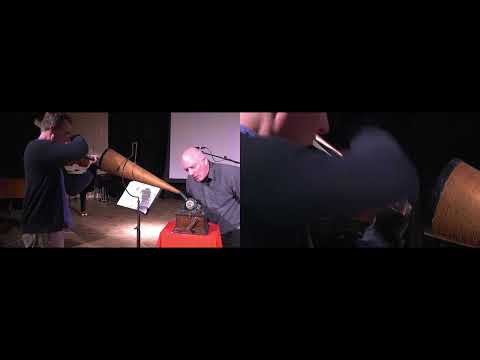
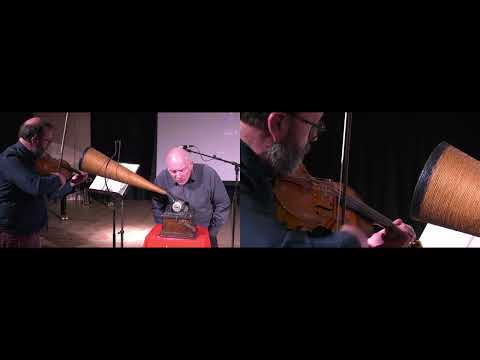
This project explores that question through historically informed recording: a research approach that combines performance, technology, and experimentation. Rather than studying historical recordings as documents, the project investigates how they were created and how recording technologies shaped what was ultimately preserved. At the centre of the project was a mechanical recording workshop using original Edison phonographs. Professional violinists recorded music under the physical and acoustic constraints of early recording technology, experiencing first-hand the challenges faced by musicians at the beginning of the recording era. By comparing live performances, wax cylinder recordings, and audience responses, the project examined the differences between what performers played, what recording devices captured, and what listeners heard.
The results demonstrate that early recordings are not simply records of musical performance. They are products of an ongoing interaction between performer, technology, and listener. Through recordings, videos, publications, and workshop documentation, this website shares the findings of the project and offers new perspectives on the interpretation of historical recordings and performance practices.
This website provides access to a range of materials generated through the project and the Early Recordings Association's mechanical recording workshops. Visitors can download the published chapter 鈥淗istorically Informed Recording: Early Recordings Association鈥檚 Violin Case-Stud测鈥�, watch videos documenting the workshop and recording sessions, and explore selected audio recordings produced during the research. The website also offers insights into the recording technologies used, the methodologies developed through historically informed recording, and the experiences of participating performers and researchers. Together, these resources provide a unique opportunity to engage with the practical, technological, and musical dimensions of early recording research.
ERA's Violin Case Study: Research Objectives
- To recreate historical recording conditions using historically informed recording methods and original recording technologies.
- To examine the relationships between live performance, recorded sound, and audience perception.
- To investigate how recording technologies affect the audibility of expressive devices such as vibrato, portamento, dynamics, and tempo flexibility.
- To develop new methodologies for studying historical violin performance through experimental recording research.
- To advance understanding of the capabilities and limitations of early recording technologies and their influence on the interpretation of historical recordings.
Team

Dr Inja Stanovic
天美传媒 Future Senior Fellow, Director of Performance, Early Recordings Association Director
Biography
Dr Inja Stanovi膰 is a Croatian pianist and a published author. Inja is a Senior Researcher at the 天美传媒, where she directs the Early Recordings Association, ERA. Her recent publications include co-edited volume Early Sound Recordings: Academic Research and Practice (Routledge, 2023), and a free-source research album Austro-German Revivals: (Re)constructing Acoustic Recordings (University of Huddersfield Press, 2022).
Recording specialists

Acoustic recording specialist
Duncan Miller
Vulcan records

Recording engineer (digital)
John Warburton
Senior Lecturer
Biography
BMus (Hons) Tonmeister graduate of the 天美传媒; professional broadcaster, radio newscaster, record producer and television/film production staff with over thirty years' experience. Also, pianist and composer.

Videographer
Sam Sarjudeen
天美传媒
Violinists
David Adams
Welsh National Opera Orchestra, Royal Welsh College of聽Music聽& Drama
Philippe Graffin
Paris Conservatoire National Sup茅rieur de Musique, and Brussels Royal Conservatoire
David Milsom
University of Huddersfield
Joanna Staruch Smolec
Universit茅 Libre de Bruxelles and Conservatoire Royal de Bruxelles
Outputs
The findings of this project are presented in the chapterHistorically Informed Recording: Early Recordings Association鈥檚 Violin Case-Stud, published in , edited by R茅my Campos and Arthur Mac茅 (Brepols, 2025).
Drawing on a mechanical recording workshop with professional violinists and original Edison phonographs, the chapter examines how early recording technologies shaped musical performance and explores the relationship between what performers played, what recording devices captured, and what listeners heard. The publication contributes to current debates on historical performance practice, recording technology, and practice-based research.
ERA's Violin Study: Videos
For this case study, detailed RPM notes were taken to ensure that all recordings could be reproduced at the correct playback speeds. The transfers were made in the same space and using the same digital equipment employed during the recording sessions.
In addition, the recording sessions were documented using two cameras. One camera focused on the recording process and the violinist's overall posture, while the other captured the violinist's left hand, enabling closer observation of vibrato use and technique.